A medieval device for training the soul in prayer. London, British Library, Arundel 83, fol. 129v This wheel contains seven rings, one depending on the other. Through the first the second is gained; through the second the third, and so with the others by reading between each pair of radii. The first ring of this wheel contains the seven petitions of the Lord’s prayer. The second ring contains the seven sacraments of the Church. The third ring contains the seven gifts of the Holy Spirit. The fourth ring contains the seven spiritual weapons of the virtues. The fifth ring contains the seven corporeal and spiritual works of mercy. The sixth ring contains the seven principal virtues. The seventh ring contains the seven criminal vices. Begin to read at the P and complete the readings that are contained between each two radii. 1. Our Father who art in heaven, hallowed be thy Name. Here we pray to become sons of God the Father. Through this is given ba...
My comments for a conversation with Fr. Peter Funk, OSB, Prior of the Monastery of the Holy Cross, sponsored by the Lumen Christi Institute Abstract : Many traditional Christian beliefs and teachings about spiritual realities have become unpalatable to modern sensibilities. Accounts of angelic visitations, demonic possessions, the stain of original sin, and the threat of eternal torment are today considered untrue or irrelevant by non-believers and even many Christians. Why were such “myths” so central to Christian belief and practice for so many centuries? Is there any value in understanding why ancient, medieval, and contemporary Christians believe in such things? Or does Christianity need to be demythologized in order to survive in a post-enlightenment age? In this conversation, Rachel Fulton Brown and Fr. Peter Funk, OSB, will consider the history of these “myths” and their relevance for contemporary spiritual practices. ***** How many of you believe in angels...
I was very happy to join Tom Rowsell on Survive the Jive for a conversation about my experience in academia as a Christian and the problem of getting inside the medieval mind. Which is harder: thinking like an academic or thinking like a medieval Christian?! Join us to find out! For a complete list of my video, radio, and podcast appearances, see Bear On Air .
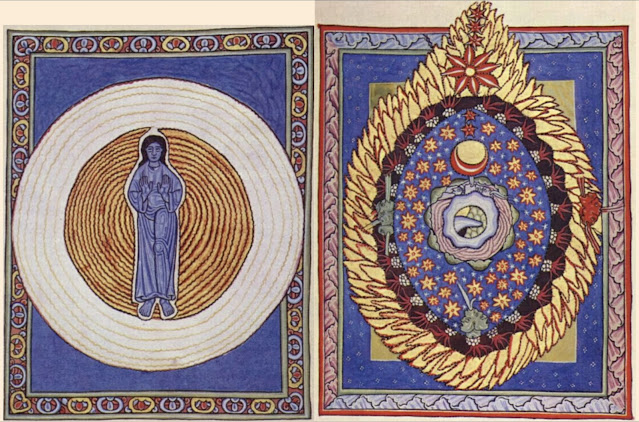
The Trinity in the Unity, and The Cosmic Egg Hildegard of Bingen, Scivias , II.ii and I.iii Rüdesheim/Eibingen, Benediktinerinnenabtei St. Hildegard, MS 1, fols. 47r and 14r Act I, scene i 1 A band of crystal lit with heaven’s fire burst o’er the earth and flashed across the plain, reverberating through the raining pyre of stories sung in cities built by Cain. A pinioned cloud danced rings around the flame, its cooing harmonized with chords of grace. A deep base note encoded love reclaimed from kingdom’s fall of mankind’s ancient race. The resonating wings revealed a clouded face. 2 The pigeon ether undulated free, an orchestra of feathers white as frost. The wingéd loom descended on the sea; from light it spun a subatomic cross. Bright feathers knit atomic Helios, while oscillating sparks set fire to quills. Reverberating wings turned light to dust. The looming man from loom that seemed to trill emerged in flesh from cloud of sapphire-blue beryl. 3 The chorus swelle...
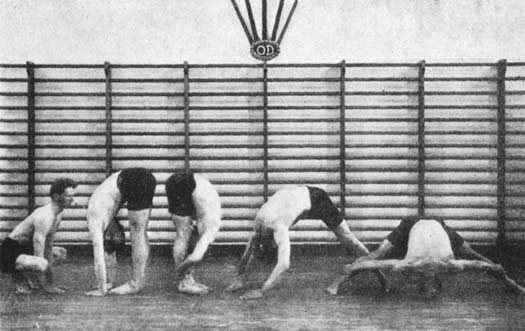
I knew it, I knew it! I have long been suspicious of the claims that my yoga teachers have made about the great antiquity of the postures that they were teaching us. Okay, so there were sculptures of yogis and Buddhas sitting in Lotus, but where were all the Downward Dogs and Warriors, Headstands and Forward Bends? Why couldn't any of the books show us illustrations or even properly referenced descriptions of these poses in the ancient sources if there were any? Well, as historian Mark Singleton has recently reported in Yoga Journal (November 2010), it's because there aren't.* It gets better (or worse, depending on how important you think antiquity is). Not only aren't these poses--and more or less all of the others which aspiring yogis and yoginis practice so diligently in yoga studios and health clubs the (Westernized) world over--particularly ancient. They aren't even Indian. They are, you guessed it, Western to begin with. To be exact, 19th-century...


Comments
Post a Comment
Thank you for taking the time to respond to my blog post. I look forward to hearing what you think!
F.B.