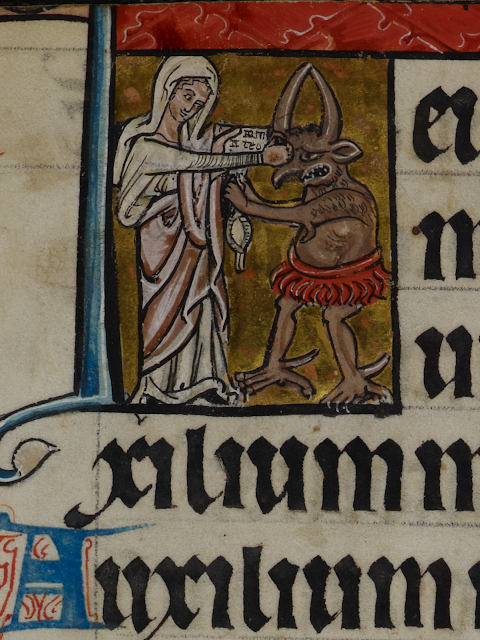
Once upon a time, there was a man named Theophilus who made a bargain with the devil. Thank God that Our Lady was able to help him! Do you want to know the full story? Listen here ! * The Prayer of Theophilus O miserable wretch that I am, what have I done and what have I wrought?... Where shall I, unhappy sinner, go, who have denied my Christ and his holy mother ( Christum meum et sanctam eius genitricem ) and have made myself a servant of the devil ( seruum diaboli ) through a chirograph of wicked warrant ( per nefande cautionis chirographum )? Who, do you think, will be able to pull it away from the hand of the devil, the destroyer, and help me? Why was it necessary for me to become acquainted with that wicked Hebrew who should be burned? (For this same Hebrew had been condemned a little while before by law and judge.) Why indeed? For thus are they honored, who forsaking God and the Lord, run to the devil.... Woe ...
Here be dragons. And doves. Human beings long for transcendence. Such longing is, for the world, always out of fashion because, of course, it is not a longing for the world, and the world knows it. We know what the world wants. The world—by which we mean Satan, the Lord of the World—wants above all our obedience, a jewel so precious that he will do anything to get it: lie, steal, murder, bear false witness, pretend to social standing, pretend to insider knowledge to get us to consent to his influence. “God lied to you. You will not die.” And suddenly we are anxious about having other people dislike us, about losing prestige in our social circles, about other people being more popular or influential or successful, about other people having secret knowledge, about our own influence and fame. “You shall be as gods, knowing good and evil.” And with that temptation, our first parents fell. The irony is cosmic. There they were in the Garden, privy to conversation with God face-to-face, ...
Like Jesus , Francis of Assisi did some pretty outrageous things. Everybody knows how he went and preached to the birds, but not everybody knows why he did it. It wasn't, as certain 1970s movies would have it, because he was a nature-loving hippie (although I do love Donavan's soundtrack, especially the theme song). It was because the human beings he was preaching to wouldn't listen. He had wanted to preach the word of God in Rome, but when he arrived there, the people scorned him because he was dressed poorly, so they thought him an idiot. He tried for several days to gain their attention, but could not overcome their hardness of heart. "I grieve deeply over your misfortune," he told them, "because you are not only spurning me as a servant of Christ, but you are also really despising Him in me, since I have been preaching to you the Gospel of the Redeemer of the world. And so I am now leaving Rome. And I call as witness of your desolation Him who is t...
As I am sure you are all aware, a few weeks ago, John Ellison, the Dean of Students in the College at the University of Chicago, sent a letter out to all of our incoming freshman in which he described some of the things that they should expect--and not expect--to encounter as students in the College. "One of the University of Chicago's defining characteristics," he told them, "is our commitment to freedom of inquiry and expression.... Members of our community are encouraged to speak, write, listen, challenge and learn, without fear of censorship. Civility and mutual respect are vital to all of us, and freedom of expression does not mean the freedom to harass or threaten others. You will find that we expect members of our community to be engaged in rigorous debate, discussion, and even disagreement. At times this may challenge you and even cause discomfort." Not, arguably, all that remarkable a claim, you might think. Of course our students should expect to fee...
Evil does not exist except as a corruption of the Good. Every falsehood or lie contains something of Truth. The same is true of heresies. Every heresy is a corruption of some aspect of orthodox doctrine, which is why heresies are so hard for the orthodox to answer . The orthodox trip themselves up trying to negate the heresies directly, which they cannot do without denying the truth and goodness at their core. This is why conservatives have so much trouble answering the Left (other than the fact that, as Milo rightly says, we are too often spineless cunts ). Everything that the Left believes is grounded in a central claim of Western civilization, more often than not a central claim of Christianity or the Judeo-Christian tradition. The Left, of course, denies this hotly, pointing for support for their doctrines to the "scientific teachings" of the prophet Marx or the "Enlightened" ideals of the prophet Robespierre . But the Left defend their beliefs with the vehe...