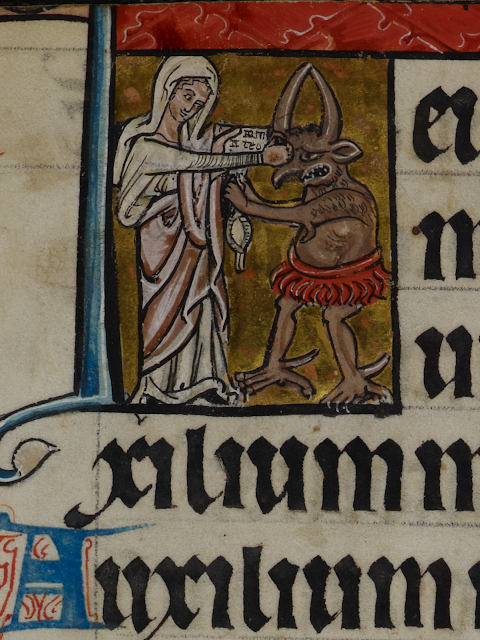
Once upon a time, there was a man named Theophilus who made a bargain with the devil. Thank God that Our Lady was able to help him! Do you want to know the full story? Listen here ! * The Prayer of Theophilus O miserable wretch that I am, what have I done and what have I wrought?... Where shall I, unhappy sinner, go, who have denied my Christ and his holy mother ( Christum meum et sanctam eius genitricem ) and have made myself a servant of the devil ( seruum diaboli ) through a chirograph of wicked warrant ( per nefande cautionis chirographum )? Who, do you think, will be able to pull it away from the hand of the devil, the destroyer, and help me? Why was it necessary for me to become acquainted with that wicked Hebrew who should be burned? (For this same Hebrew had been condemned a little while before by law and judge.) Why indeed? For thus are they honored, who forsaking God and the Lord, run to the devil.... Woe ...
It is difficult to describe the crisis I have been living through these past several weeks. The drawing by my office door Short version : Don’t call out the Devil if you aren’t ready to bout . Alternative short version : “Where is the wise? Where is the scribe? Where is the disputer of this world? Hath not God made foolish the wisdom of the world?” —1 Corinthians 1:20 There has been much bitterness. There have been feelings of betrayal. There have been feelings of being lied to while watching people whom I thought were my supporters fall away. Friends warn me about overreacting. At which I overreact. “Academic freedom means nothing if the faculty do not stand up for it.” I believed that. Someone whom I have trusted my entire academic career told me that. I still believe it—but do my colleagues? “Any sufficiently advanced intelligence is indistinguishable from insanity.” I heard someone say that recently on his livestream. Someone whom my friends tell me I s...
Here be dragons. And doves. Human beings long for transcendence. Such longing is, for the world, always out of fashion because, of course, it is not a longing for the world, and the world knows it. We know what the world wants. The world—by which we mean Satan, the Lord of the World—wants above all our obedience, a jewel so precious that he will do anything to get it: lie, steal, murder, bear false witness, pretend to social standing, pretend to insider knowledge to get us to consent to his influence. “God lied to you. You will not die.” And suddenly we are anxious about having other people dislike us, about losing prestige in our social circles, about other people being more popular or influential or successful, about other people having secret knowledge, about our own influence and fame. “You shall be as gods, knowing good and evil.” And with that temptation, our first parents fell. The irony is cosmic. There they were in the Garden, privy to conversation with God face-to-face, ...
"Just as the Nazi attack on Christianity was part of a larger war on the idea of universal truth, whole postmodern cosmologies have been created to prove that traditional religious morality is a scam, that there are no fixed truths or 'natural' categories, and that all knowledge is socially constructed. Or as the line goes in The Da Vinci Code , 'So Dark, the Con of Man.' "The 'con' in question is, in effect, a conspiracy by the Catholic Church to deceive the world about Jesus' true nature and his marriage to Mary Magdalene. The book has sold some sixty million copies worldwide. The novel, and movie, have generated debates, documentaries, companion books, and the like. But few have called attention to the ominous roots and parallels with Nazi thought. "Dan Brown should have dedicated his book to 'Madame' Helena Blavatsky, the theosophist guru who is widely considered the 'mother' of New Age spirituality as well as a to...
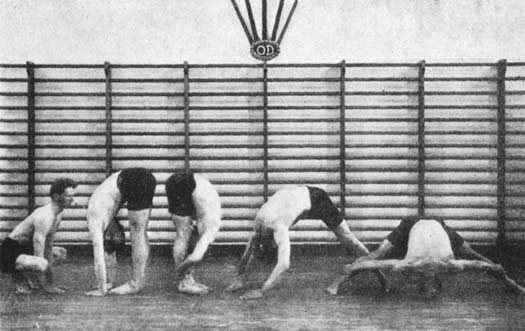
I knew it, I knew it! I have long been suspicious of the claims that my yoga teachers have made about the great antiquity of the postures that they were teaching us. Okay, so there were sculptures of yogis and Buddhas sitting in Lotus, but where were all the Downward Dogs and Warriors, Headstands and Forward Bends? Why couldn't any of the books show us illustrations or even properly referenced descriptions of these poses in the ancient sources if there were any? Well, as historian Mark Singleton has recently reported in Yoga Journal (November 2010), it's because there aren't.* It gets better (or worse, depending on how important you think antiquity is). Not only aren't these poses--and more or less all of the others which aspiring yogis and yoginis practice so diligently in yoga studios and health clubs the (Westernized) world over--particularly ancient. They aren't even Indian. They are, you guessed it, Western to begin with. To be exact, 19th-century...




Comments
Post a Comment
Thank you for taking the time to respond to my blog post. I look forward to hearing what you think!
F.B.