“He who controls the spice controls the universe.” — Frank Herbert, Dune (1965) It came to me in a flash last summer . Why the United States of America had spent the past two decades trying to control Afghanistan. Why Big Pharma was pushing the vaccines. It was the spice. The opium of the poppy fields. The opioids of Big Pharma. Everything was about controlling the spice. And always had been. Once upon a time, there was a Silk Road. You’ve heard of it I’m sure. The caravan road across the middle of the great Eurasian continent, linking the treasures of the Orient with the markets of the West. Except throughout the Middle Ages, the markets in the West weren’t much to speak of. A few Italian city-states. A few burghers in the north. Back in high school, I did a presentation about the fairs where they sold their spices. I even wore a costume—a hat that I got at the Renaissance Faire north of Houston, the autumn before I started college there...
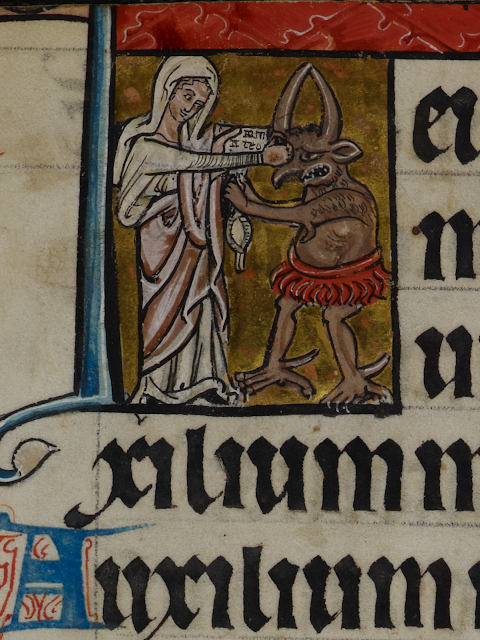
My comments for a conversation with Fr. Peter Funk, OSB, Prior of the Monastery of the Holy Cross, sponsored by the Lumen Christi Institute Abstract : Many traditional Christian beliefs and teachings about spiritual realities have become unpalatable to modern sensibilities. Accounts of angelic visitations, demonic possessions, the stain of original sin, and the threat of eternal torment are today considered untrue or irrelevant by non-believers and even many Christians. Why were such “myths” so central to Christian belief and practice for so many centuries? Is there any value in understanding why ancient, medieval, and contemporary Christians believe in such things? Or does Christianity need to be demythologized in order to survive in a post-enlightenment age? In this conversation, Rachel Fulton Brown and Fr. Peter Funk, OSB, will consider the history of these “myths” and their relevance for contemporary spiritual practices. ***** How many of you believe in angels...
1. When white women (see Marie de France and Eleanor of Aquitaine) invented chivalry and courtly love , white men agreed that it was better for knights to spend their time protecting women rather than raping them, and even agreed to write songs for them rather than expecting them to want to have sex with them without being forced. 2. When white men who were celibate (see the canon lawyers and theologians of the twelfth century and thereafter) argued that marriage was a sacrament valid only if both the man and the woman consented , white men exerted themselves to become good husbands rather than expecting women to live as their slaves. 3. When white women (see Christine de Pizan, Mary Wollstonecraft, and the suffragettes) invented feminism , white men supported them (see John Stuart Mill) and even went so far as to vote (because only men could vote at the time) to let them vote, not to mention hiring them as workers and supporting their education. And before you start telling me a...
Professor Kim READ FIRST: Why Dorothy Kim Hates Me , The Color of the House of the Lord It’s back to class for those of us who teach in medieval studies, and my medievalist colleague Dorothy Kim , Assistant Professor of English at Vassar College ( pictured in 2014 ), wants to make sure you understand the stakes . The medieval western European Christian past is being weaponized by white supremacist/white nationalist/KKK/nazi extremist groups who also frequently happen to be college students. That does sound bad. But, wait, it gets worse! Don’t think western European medieval studies is exceptional.... ISIS/ISIL also weaponizes the idea of the pure medieval Islamic past in their recruiting rhetoric for young male Muslims. If the medieval past (globally) is being weaponized for the aims of extreme, violent supremacist groups, what are you doing, medievalists, in your classrooms? Because you are the authorities teaching medieval subjects in the classroom, you are, in ...
This is not the post I had planned to write today, the first day I have had to blog properly since January, but tragedy intervened in Christchurch, so I will save my meditations on the meaning of race and gender as status markers in egalitarian democracy for another day. Today we are praying for the dead . Forty-nine people were killed in New Zealand as they gathered together for Friday prayers, forty-one at Masjid Al Noor Mosque, seven at Linwood Masjid Mosque, and one who died later in hospital. The dead include children. The shooter—may his time in purgatory be excruciating—has provided the internet with a “ manifesto ” on his “reasoning” for the attack, which has prompted the usual—one might almost say— scripted responses we have come to expect . Friends on Facebook—well, one friend in particular—have drawn attention to the manifesto’s use of the “14 words” typically cited as evidence that one is in the presence of Evil, a.k.a. “right wing extremism.” Except that the ...
Comments
Post a Comment
Thank you for taking the time to respond to my blog post. I look forward to hearing what you think!
F.B.