Posts

Showing posts with the label history

The Study of Religion and the Teaching of History

AHA Session 267 Sunday, January 6, 2013, 11:00AM-1:00PM Roosevelt Ballroom II (Roosevelt New Orleans) Today is the feast of the Epiphany, the manifestation or appearance of God.  Today Christians celebrate the revelation of the Son of the Most High in the person of Jesus Christ.  Traditionally, in the West, the day was marked by the story of the visit of the Magi; in the East, it is marked as the day on which Jesus was baptized in the Jordan by his cousin John.  Both were instances of revelation, of God's becoming present to the world, not mystically or spiritually, but actually, in the body of a baby born of a woman, in the body of a man anointed by the Holy Spirit and acknowledged by a voice from heaven as God's Son. So what?  What does this feast have to do with us, sitting here in this hotel conference room rather than in the pews of a church?  Is it appropriate to call our attention to the fact that in the Christian calendar, today is one of the holie...
“Honey, I shrunk the Middle Ages!"

"An overarching conception of medieval culture has fallen into place since the late nineteenth century, which I will call the diminutive Middle Ages (DMA).  DMA is the internalized and sublimated scholarly consensus of a generation of titanic post-romantic and anti-romantic medievalist scholars, a model that has seeped into and saturated current thinking about the Middle Ages, not only in specialized scholarship.  Like embedded levels of software programs, this model sets and limits what can be thought and claimed about medieval culture, and occasionally overrides empirical observation... "Viewed through the lens of DMA, the Middle Ages is a period of small, quaint things and people, of miniatures, humble, little, overshadowed by its big neighbors--antiquity in its past and the Renaissance in its future--a conduit between the two; full of ingenious people and little intricate objects; a curiosity cabinet full to overflowing; a treasure trove of folklore, superstition, and w...

Reforming the Reformation: A Review

This is what I would have said back in January if I had had the time to finish the book then.  We're having a discussion about it here on campus this week , if you want to know more.   This is what I'll be saying, more or less. Comment on Brad S. Gregory, The Unintended Reformation: How a Religious Revolution Secularized Society (Cambridge, Mass.: Harvard University Press, 2012). This is an intimidating book.  It is also a book that is very difficult to summarize.  Not only does it take on the whole of European history from the high Middle Ages to the present; it also critiques the very historiography upon which our narrative of European (and, by the by, American and, indeed, world) history has tended to depend.  Name something—anything—that you know about the development of the modern world and Prof. Gregory’s book will have something to say about it—and then it will show you how everything that you have ever believed about it is wrong.  The triump...

Ready, Set, ...Write!

I can't.  I'm too tired.  I have nothing to say.  No, as usual, that's not quite true.  Thanks to the reading I've been doing these past four or so weeks , I have much, too much to say.  If only I knew where to start.  If only. I am tired.  Truly.  It's the second week of term, and I'm teaching a wholly new course on education in the Middle Ages.  I know, I know, it was the Dark Ages, they didn't have any education.  Which, of course, isn't true.  They had loads.  Only--and here's the embarrassing thing--even we medievalists don't spend enough time thinking about what medieval people (i.e. school children) learned in school.  In particular, we don't spend enough time thinking about grammar.  And logic.  And rhetoric.  A.k.a. the trivium . I know I don't.  I'm embarrassed that my Latin isn't stronger than it is.  Even after almost a full year of working on my translation of John of Garland ....

Why Study the Past

So that we neither idolize it nor demonize it, neither expect it to provide all the answers (as in the Renaissance), nor blame it for all of the things that we see wrong about our own day (as in the Reformation).  There was never a Golden Age in which everything was idyllic or perfect; there has never been a Turning Point after everything went wrong (or right).  The past has always been just like the present, mixed up, contrary, the best of times and the worst of times all at the same time.  Traditions have always been both good and bad, institutions have always been subject to innovation and change.  There have always been people eager to take advantage of others; there have always been people willing to help.  It does no good, therefore, to pretend that we who are alive now are either better or worse, wiser or more corrupt, more or less virtuous or vicious than those who have come before us.  If we are wise, we will learn from them; such is the gift of ci...

My Fifteen Minutes

Or thereabouts.  Talking about history with Milt Rosenberg, Constantin Fasolt and Robert Bucholz last night on WGN Extension 720 . Oh, this is a lot of attention for a very shy bear!  It's taken me all day to come down from the anxiety. Please be gentle with your comments, I'm not used to having my voice broadcast in quite this way.

Why Life in the Academy (Especially the Humanities) Sucks

I don't want to be writing this post; no matter what I write is going to feel inadequate. But I feel like I should say something about that xtranormal video " So you want to get a PhD in the Humanities ?" that everyone is talking about . I've only watched it once and don't feel like reliving that particular experience again, so bitter and (horrible to have to admit) true-to-life did it feel the first time that I watched it. As, it seems from the comments on the video itself, many of my colleagues in academia concurred. But why? Why are we all so convinced that the life we have taken on is so utterly bankrupt that all we can do is roll around on the floor laughing our asses off because a (we all say) justifiably-bitter graduate student has parodied the death of our dreams so well? The dismal job market, we say. The low pay, we say. The lack of respect in the general culture, we say. But why then do so many of us who have gotten not only tenure-track jobs...

The Mists of Time

Beliefs that date back to 1850 (give or take a decade or so) that proverbially belong to an earlier era: 1. The code of chivalry 2. "Feudalism" as a method of economic exploitation 3. Yoga as system of breathing and postures for the integration of mind, body and soul 4. The Ages of Faith 5. The battle between science and religion 6. The battle between Church and State 7. Blacksmiths as craftsmen with near-magical powers 8. Witches as goddess-worshipers 9. Believing that the world was flat 10. Papal infallibility in the pronouncement of doctrine 11. St. Thomas Aquinas as the teacher of Christian doctrine 12. Religion as something that you feel rather than understand and that should be relevant and accessible to the "common" man 13. History repeats itself I have proofs for all of this (or know the bibliography that proves it), but why should I show my sources when everybody is convinced that these things have always been true "whatever the sources ...

Christian Yoga

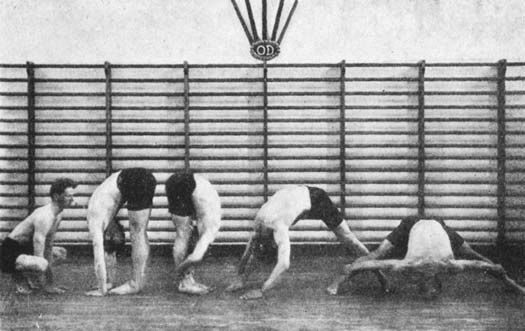
It gets even better . Yoga as we now know it both in East and West--specifically, as a system of postures and other practices intended for the physical health and spiritual well-being of the individual as opposed to an ascetic discipline akin to the austerities of the Desert Fathers of antiquity--is not just Western, it's Christian. According to historian and yoga teacher Mark Singleton, Yoga Body: The Origins of Modern Posture Practice (Oxford, 2010), Kindle location 1855ff. (emphasis added), "No organization had a greater influence on the international diffusion of physical culture than the YMCA. Indeed, it was in the creation of a hybridized but distinctly Indian culture of sport and exercise that the YMCA offered its most significant contribution 'to the making of modern India' (David 1992: 17). Its physical culture programs were explicitly intended to function as a somatic tool of moral reform, whose core values were those of the Christian West, and in partic...

Yoga As We Know It

Image
I knew it, I knew it! I have long been suspicious of the claims that my yoga teachers have made about the great antiquity of the postures that they were teaching us. Okay, so there were sculptures of yogis and Buddhas sitting in Lotus, but where were all the Downward Dogs and Warriors, Headstands and Forward Bends? Why couldn't any of the books show us illustrations or even properly referenced descriptions of these poses in the ancient sources if there were any? Well, as historian Mark Singleton has recently reported in Yoga Journal (November 2010), it's because there aren't.* It gets better (or worse, depending on how important you think antiquity is). Not only aren't these poses--and more or less all of the others which aspiring yogis and yoginis practice so diligently in yoga studios and health clubs the (Westernized) world over--particularly ancient. They aren't even Indian. They are, you guessed it, Western to begin with. To be exact, 19th-century...

An Experiment

How do you encourage your students to take risks with their writing while at the same time validating it as something worth reading by somebody other than just their professor? We shall see...

Why I Study the Middle Ages

I always wonder what people hope I will say when they ask me this question. Do they imagine that I had some great revelation when I was (I don't know) six that studying the Middle Ages was to be the purpose of my life? Maybe the Virgin Mary appeared to me when I was ten and told me that she wanted me to serve her by studying the history of her cult. Or maybe I spent my childhood reading nothing but books on history, certain that I would dedicate my life to unraveling the mysteries of causation and chronology, by the by rescuing the Middle Ages from its modernist critique. If only. I can't tell you how often I've wished that there were a clear-cut, easily-narrated justification for my interest. Typically, when asked The Question, I dodge, mumbling something about having taken Latin in high school or having gone on an ALSG trip to Europe when I was 16. "I really liked Europe," I might say. Or, "I was so impressed with the Gothic cathedrals," I migh...

Audience of One

My husband says it is quite simple, really: the one for whom I should be writing is the Virgin Mary. She is not, he insists, served as well in the modern scholarship as I have claimed she is, and she wants me to write the history of her devotion. Indeed, she insists. Moreover, she--and God--want me to write history, not theology or some other form of criticism. "God means you to be an historian," my husband said last night after reading my blog posts from yesterday. So, there you go. I need to start writing history in service to the Mother of God.

What'sitreallymeanwhenallissaidanddone?

I'm sitting in the garden with the dog, feeling the heat and thinking about how I really need a shower before going to our counseling session tonight, wishing that this morning's blog post had given me the answer to my question about what to write, and reading Thirty-three Teeth , the second of Colin Cotterill's delightful mystery series set in the 1970s People's Democratic Republic (a.k.a. communist state) of Laos. If you haven't read them yet, you should. The main character is Dr. Siri Paiboun, a 72-year-old former revolutionary reluctantly-turned coroner and even more reluctantly-identified shaman, who spends a good deal of his time, when he is not doing autopsies and receiving dreams from the spirit world, drinking with his old friends and (as in Thirty-three Teeth ) sometimes his (former) enemies and coming to terms with the fact that the new government for which they fought so long is well on its way to becoming just as corrupt at the old. (In Thirty-three...

Looking Along the Beam

Thanks to Luo , I am now feeling much more hopeful about "Fencing Bear at Prayer" as a project. Indeed, Luo has given me a wonderful way to conceptualize it: "What you're doing in this blog is more like what a 'real' medieval/monastic writer would do, perhaps? Writing is like wandering in a dark forest of words and thoughts. We dabble, linger, constantly get lost, but also run into the marvelous. I assumed that this blog, with its monologue and contemplation, was part of your academic project, in which the aesthetic and personal experience is an important subject?" To which I can only reply: "Yes! Yes! Yes! But..." But how much does the aesthetic and, even more to the point, personal experience belong in an academic project, if at all? This--I realized as I walked into campus with Joy this morning to mail in my passport application , pick up the gadgets that I ordered to go with my new toy , sort my emails and update my homepage --i...